Ad Rank
AdGroups
AdWords Explained
Adwords Updates
Google Analytics
PLA
PPC Account
PPC Bidding
SEM
SEM Strategies
SEM Updates
For Better Attribution Modeling – Do We Use AdWords or Analytics?
- Credit goes to Corina Marcano (original author) & PPCHero.com Original link
A few days back I read this post about AdWords’ Attribution Modeling being released within the UI. It is a great feature to have in AdWords, but as mentioned in the post, this information does not show us the whole story. In this article I will compare Attribution Modeling in AdWords and Analytics.
What are the main differences in how Attribution Modeling works in AdWords and Analytics?
AdWords Attribution Models allow us to understand how PPC campaigns interact with each other, while Analytics Attribution Models allows us to understand how multi-channels interact with each other during the conversion path.
Putting aside the fact that Analytics is able to show multi-channel interactions while AdWords isn’t, I will limit this analysis to PPC data. There are a few specific models in Analytics that seem interesting to define:
Another important difference is the expiration of each cookie. The default expiration time of AdWords’ cookie is 30 days while the expiration of the Google Analytics campaign cookie (__utmz) is set to 6 months by default.
For example, if you click on an ad and then come back directly from a bookmark, or by directly typing the URL within 30 days, this conversion will be attributed to your PPC campaign and accounted for in AdWords (attributed to the day of the click). This will not be the case if the conversion happens on day 31. However, Analytics will attribute this last conversion to AdWords (CPC) on the date it happened.
If you need to better understand the differences between AdWords and Analytics regarding conversion data, I strongly recommend reading this post.
Let’s look at it with a more specific example
I chose a few campaigns that were paused on December 31st so no additional conversions will be attributed to them in AdWords because of the 30 day window.
1. For December 2013, this is the information I received from AdWords:

As you see on the last line, there is no difference on the total conversions between each model. This is because with Attribution Models within AdWords, you are only able to see how your AdWords campaigns interacted with each other, but you cannot see how they impacted other sources of traffic.
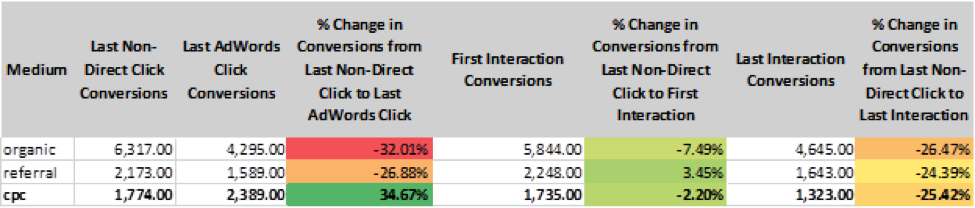
2. For the same month, this is the information I received from Analytics:

The information we see in AdWords corresponds to the Model of “Last Non-Direct Click Conversions”. If we look closely at the data for the model “Last AdWords Click Conversion” we realize that CPC contributed to almost 35% more conversions than what it is accounted for in AdWords. Similarly, looking at the “First Interaction Model” and the “Last Interaction Model” we realize that AdWords has been credited for 2.2% more and 25% more conversions respectively when users came back directly to the website or through a bookmark.
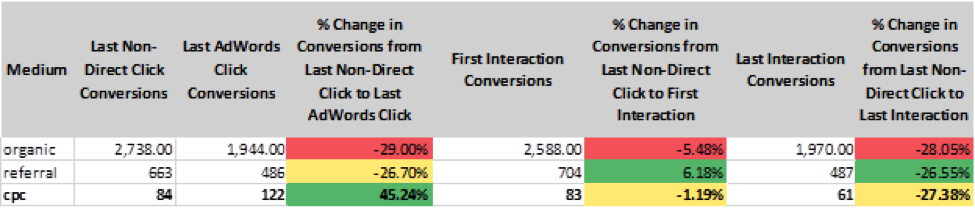
Looking at the same data in Analytics, but for February 2014, I noticed the following:

CPC is still getting conversions attributed to after the campaigns have been paused and the 30 day window has expired!
PPC, a part of a whole
PPC should not be analyzed by itself. It is a piece, small or big, of a bigger puzzle and these campaigns have a lot more impact on bringing conversions than what we are able to see within AdWords. Analytics allows us to see a greater part of the puzzle and this is exactly the type of information that will definitely help us, digital marketers, to explain to clients the real impact PPC.
As Google evangelist Avinash Kaushik would say, “Optimize for the journey, not for a one night stand”.
So which one do you think is better?
*Note that the differences in Last non-direct click conversions (Analytics Chart) and Conversions (AdWords chart) are due to the 30 days window attribution, the time duration of each cookie, and the date the conversion is accounted for.
A few days back I read this post about AdWords’ Attribution Modeling being released within the UI. It is a great feature to have in AdWords, but as mentioned in the post, this information does not show us the whole story. In this article I will compare Attribution Modeling in AdWords and Analytics.
What are the main differences in how Attribution Modeling works in AdWords and Analytics?
AdWords Attribution Models allow us to understand how PPC campaigns interact with each other, while Analytics Attribution Models allows us to understand how multi-channels interact with each other during the conversion path.
Putting aside the fact that Analytics is able to show multi-channel interactions while AdWords isn’t, I will limit this analysis to PPC data. There are a few specific models in Analytics that seem interesting to define:
- Last AdWords Click: This model attributes 100% of the conversion value to the most recent AdWords ad that the consumer clicked on before converting. So if a consumer clicked once on your ad and then converted from another source of traffic, this type of model will attribute the conversion to the last clicked AdWords campaign.
- Last Interaction: This model attributes the conversion to the last touch point from ALL sources of traffic. So if you click on an ad and come back directly a week later and converted, Analytics will not attribute this conversion to AdWords but to direct traffic.
- First Interaction: This model attributes the conversion to the first touch point from ALL sources of traffic. So if you click on an ad and come back organically a week later and converted, Analytics will attribute this conversion to AdWords and not to organic traffic.
- The Custom Model: The most important model! In this model it is you who decides the rules of attribution. Imagine that you are running branded and generic campaigns. Maybe your client thinks that branded conversions are not as valuable as generic since the consumer was already looking for their brand. This type of model will allow you to assign a specific value to brand conversions compared to generic conversions. You could say that you want each branded conversion to be counted as half of a generic conversion.
Another important difference is the expiration of each cookie. The default expiration time of AdWords’ cookie is 30 days while the expiration of the Google Analytics campaign cookie (__utmz) is set to 6 months by default.
For example, if you click on an ad and then come back directly from a bookmark, or by directly typing the URL within 30 days, this conversion will be attributed to your PPC campaign and accounted for in AdWords (attributed to the day of the click). This will not be the case if the conversion happens on day 31. However, Analytics will attribute this last conversion to AdWords (CPC) on the date it happened.
If you need to better understand the differences between AdWords and Analytics regarding conversion data, I strongly recommend reading this post.
Let’s look at it with a more specific example
I chose a few campaigns that were paused on December 31st so no additional conversions will be attributed to them in AdWords because of the 30 day window.
1. For December 2013, this is the information I received from AdWords:

As you see on the last line, there is no difference on the total conversions between each model. This is because with Attribution Models within AdWords, you are only able to see how your AdWords campaigns interacted with each other, but you cannot see how they impacted other sources of traffic.
2. For the same month, this is the information I received from Analytics:
The information we see in AdWords corresponds to the Model of “Last Non-Direct Click Conversions”. If we look closely at the data for the model “Last AdWords Click Conversion” we realize that CPC contributed to almost 35% more conversions than what it is accounted for in AdWords. Similarly, looking at the “First Interaction Model” and the “Last Interaction Model” we realize that AdWords has been credited for 2.2% more and 25% more conversions respectively when users came back directly to the website or through a bookmark.
Looking at the same data in Analytics, but for February 2014, I noticed the following:
CPC is still getting conversions attributed to after the campaigns have been paused and the 30 day window has expired!
PPC, a part of a whole
PPC should not be analyzed by itself. It is a piece, small or big, of a bigger puzzle and these campaigns have a lot more impact on bringing conversions than what we are able to see within AdWords. Analytics allows us to see a greater part of the puzzle and this is exactly the type of information that will definitely help us, digital marketers, to explain to clients the real impact PPC.
As Google evangelist Avinash Kaushik would say, “Optimize for the journey, not for a one night stand”.
So which one do you think is better?
*Note that the differences in Last non-direct click conversions (Analytics Chart) and Conversions (AdWords chart) are due to the 30 days window attribution, the time duration of each cookie, and the date the conversion is accounted for.


